Iso story
On the basis of Wikipedia, the free encyclopedia with some updates
Iso Rivolta was an automobile and motorbike manufacturer in Italy, predominantly active from the late 1940s through the early 1970s. They are known for the iconic Isetta 'bubble car' of the 1950s, and for a number of powerful performance cars in the 60s and early 70s.
Iso Rivolta was initially named Isothermos and manufactured refrigeration units before World War II. The company was originally founded in Genoa in 1939, but was transferred to Bresso in 1942 by Renzo Rivolta, an engineer and the heir of industrialists. The business was refounded as Iso Autoveicoli S.p.A. in 1953 to reflect the production of motorized transport. Renzo Rivolta died in 1966, and his son, Piero, took over as managing director.
At the start of 1973 the Rivolta family ceded the business to an Italian American financier named Dr Ivo Pera who promised to bring American management know-how to the firm the business was again renamed to Iso Motors, just before fading rapidly into obscurity.
Early years: motorcycles
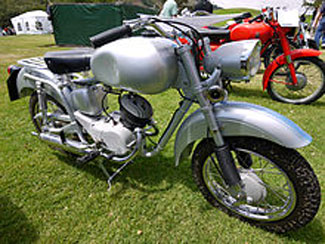
After the Second World War, the company reopened its doors, completely changing its activity. In 1948 it began to build motorcycles, scooters and motocarries (three-wheeled transport scooters/motorcycles). Among the most famous are the Furetto (1948), 'Isoscooter (1950),' Isocarro (1951), 'Isomoto (1954) and' Isosport (1953). The last Iso motorcycle was presented as the Iso 500 in 1961. Isomotos were known as expensive, but durable and well-built.
Iso 500
1950s: Isetta bubble car
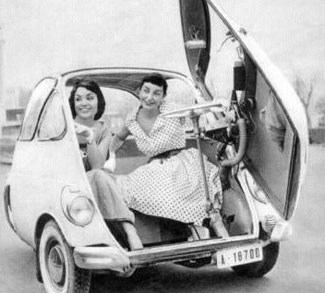
In the mid-1950s, he started to develop a miniature car for two persons and front entrance, initially with only three wheels, later, for reasons of stability, with four wheels (the two on the rear very close together): the Isetta Bubble Car. About 20,000 of the bubble cars were built at the Rivolta works near Milan. Starting in 1954, Isetta was licensed to automobile manufacturers in several countries: France (by VELAM), Spain, Great Britain and Brazil (by Romi). The most successful, however, was the German Isetta built by BMW. The BMW-Isetta went on to dwarf the production volumes of Rivolta and fulfilled the dream of mobility in post-war Germany. About 130,000 had been sold by 1962.
Isetta
1960s: performance cars
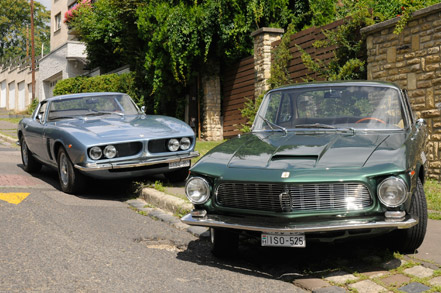
That same year Bertone showed the Grifo A3/L prototype at the Turin Auto Show, while Iso showed off the (partly unfinished) competition version; the Iso Grifo A3/C. Both were overwhelmingly successful. Although design changes had to be made to the prototype, Iso concentrated on getting the Grifo A3/L ready for production. The car got a light facelift that made it less aggressive but turned it into possibly the most elegant-looking Gran Turismo (GT) supercar ever produced. This “street” Iso Grifo GL received the fast, modified but reliable Chevrolet Corvette’s 327 V8 (5.4 L) engine—either in 300 or 350 hp—coupled to a Borg-Warner 4-speed toploader. These engines were ordered in the United States, but were completely taken apart and blueprinted before they were put in; as they did with the Iso Rivolta GT. With over 400 horsepower (300 kW) and a weight of less than 2,200 pounds (1,000 kg), the vehicle was able to reach speeds over 275 km/h (171 mph).
While Renzo Rivolta focused on the A3/L; Giotto tried to promote the A3/C—making for some tension between the two. This meant that the Grifo GL was being produced at Bresso and the A3/C at Piero Drogo’s Sports Cars of Modena under Giotto’s strict supervision. In 1964 the prototype Grifo A3/C raced at Le Mans (Edgar Berney/Pierre Noblet), running well until brake problems required a two-hour pit stop. The car then resumed the race, finally finishing in 14th place; an encouraging result for a brand-new car.
Only 22 examples of the Bizzarrini Grifo A3/C were constructed before a disagreement between Renzo and Bizzarrini ended the cooperation.
IR 300
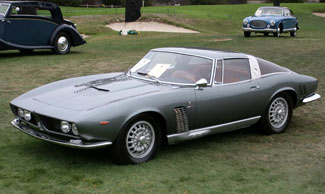
A3/L
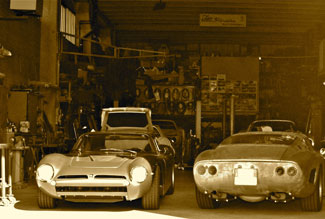
A3/C
Parting ways
Finally in 1965 Giotto Bizzarrini and Renzo Rivolta split ways, which resulted in separate production of the street Grifo GL and the competition Bizzarrini A3/C. Giotto refined his A3/C and this eventually turned out to be his line of Bizzarrini 5300 Stradas and Corsas. From here on the “Grifo” name was lost in connection to Bizzarrini.
Bizzarrini continued to build both Bizzarrini Stradas and Corsas and had the alloy bodies (put together with more than 10,000 rivets) built by BBM of Modena. In 1966 he introduced a scaled-down version, the Bizzarrini 1900 “Europa,” first shown in 1967. Most of these cars got a tuned-up version of the Opel 1900 engine, some got Alfa Romeo engines. Only about 17 Europas were ever built, making it one of the rarest of his creations. Even rarer is the Barchetta version, the P538, with only three ever produced. A total of around 155 Bizzarrini Stradas and Corsas were built before Bizzarrini closes down in 1969 after a bankruptcy; all remaining parts and cars were sold off.
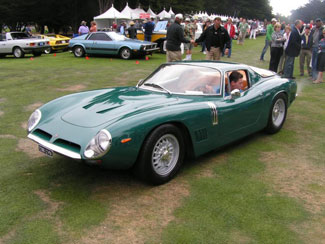
Bizzarrini 5300 GT
Production begins
The car developed 390hp (290kW) in its production form and could reach 110km/h (68mph) in first gear. Renzo Rivolta also showed a one-off Grifo A3/L Spyder at the Geneva auto show. The production of Iso Grifo GL started in 1965. In October 1966 the very first Grifo (car #97) with Targa Top was shown at Turin. This was one of 13 Series I Targas ever built; later, four series II Targas were built.
In 1968 the Grifo 7 Litri was introduced with a Chevrolet L71 big-block engine, a Tri-Power version of the 427 engine. This seven-liter power plant required changes to the car to fit, and a hood scoop was needed because of the engine's height. It produced 435hp (324kW) at 5800 rpm and the factory claimed it could reach a top speed of 300km/h (186mph). This particular 7 Litri is still lost.
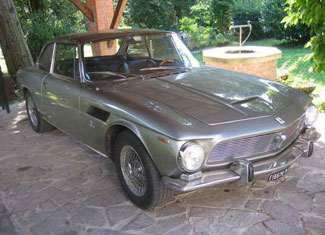
After the sudden death at Milan on 20 August 1966 of Renzo Rivolta, his son Piero became the director of Iso Rivolta, aged only 25 then. Under Piero's leadership, Iso built the limousine Fidia, "the fastest four seats on wheels" (Advertisement, 1967) with body by Ghia, the Grifo 7 litri (with the GM V8 7L marine engine) and the 2 + 2 fastback Coupé Lele (1969) with body designed by Bertone, intended as the successor to the IR 300.
Iso Rivolta went bankrupt in 1974, only 1.700 Iso Gran Turismos had been built in those ten years.
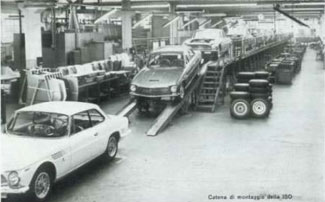
Production of the GT
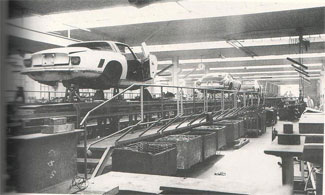
Production of the Grifo
Stylistic changes
In 1970 a styling change was made to the nose section of the car for the Grifo Series II. It got a sleeker look and hide-away headlights. In this new Series II, four Targas were built, and for the IR-9 "Can Am" version the engine was switched from the 427 engines to the newer 454 engine. Production stopped in 1972.
In 1972 Iso started to use small-block Ford Boss 351 engines; these cars (Grifo IR-8) are recognized by their taller hood scoop. This was the final version of the Iso Grifos: Iso S.P.A. closed its doors in 1974 during the oil crisis.
Collectibility In total, 330 Series I and 83 Series II cars were built for a total of 413 Grifos, 90 of which 7 Litri. The rarest are the Series II 5-speeds (23 units) and the Series II Targa (5 units). All Grifos are desirable because of their rarity. A former employee of Iso, Roberto Negri, runs a small Company in Clusone, Italy, restoring Grifos.
Main source: Wikipedia
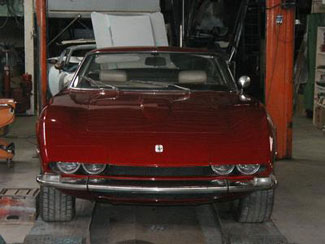
Grifo Series II.
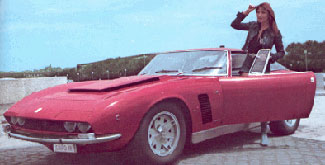
IR-9 "Can Am"